Category: Carbon Farmer of the Year

What happened at our Annual Field Day 2023

A day to glimpse the future of sustainable nature friendly farming and all the ways in which farmers are already farming to reduce greenhouse gas emissions and remove carbon from the atmosphere and store in soils and biomass.

On 21 Sep 2023, our Annual Field Day brought together alumni from the Farm Net Zero project in Cornwall alongside past and current  FCT Soil and Carbon Farmer of the Year competitions. And we were grateful to Yeo Valley, Velcourt and First Milk who helped to sponsor the day.

The event was held at Hendred Estates courtesy of Julian Gold and the estate owners. The day dawned bright and sunny unlike the day before when you could have been forgiven for thinking that we were in the eye of a tropical storm!

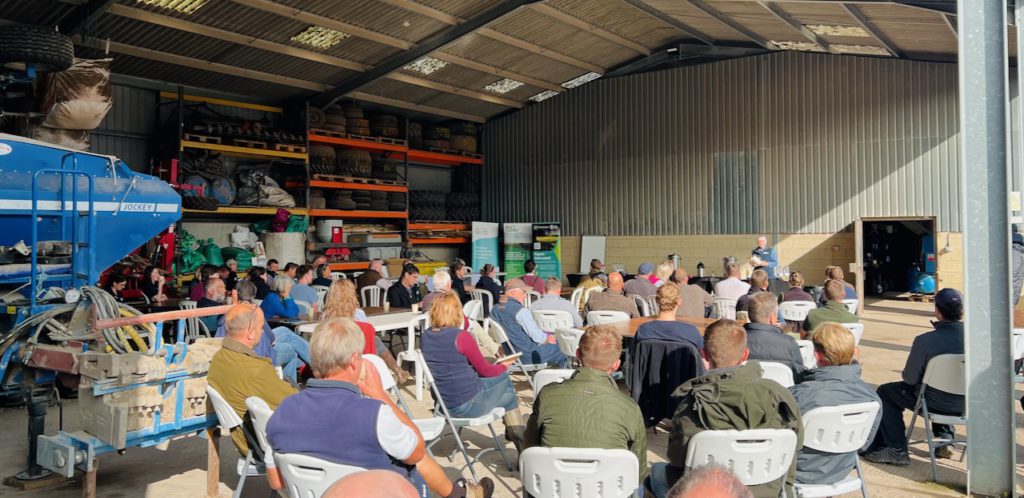
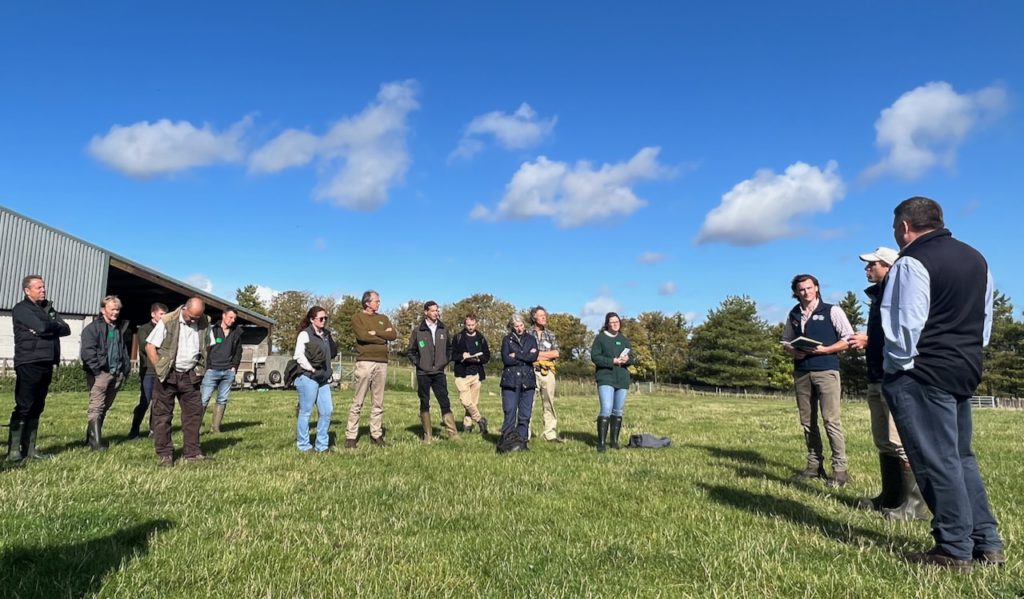
Our delegates arrived ready for a 10am start and we were off to a flying start with Julian introducing his farm and all the practices he has been finessing for many a year.
Annual Field Day 2023

Julian acknowledged that the timing of our event  was pertinent with the news that Westminster is preparing to “back off” their net zero targets but he was clear that he will be carrying on as normal with his efforts to reduce emissions .

His analogy is of “Maintaining the factory premises”: if you run a factory to produce cars, you have to maintain the factory to be able to keep the cars rolling out. In the same way, farmers need to maintain the natural processes (natural capital) the farm relies on in order to keep being able to produce food (whether or not DEFRA or anyone else are paying!).

Julian highlighted that C sequestration can only get farmers so far in terms of net zero – they need to reduce their emissions and look to innovative practices to be able to keep C in the ground. He commented that as soil carbon levels rise closer to those under the hedges (optimum levels perhaps) his ability to offset emissions with additional carbon storage will be reduced. This is something pioneers in this space will need to consider.

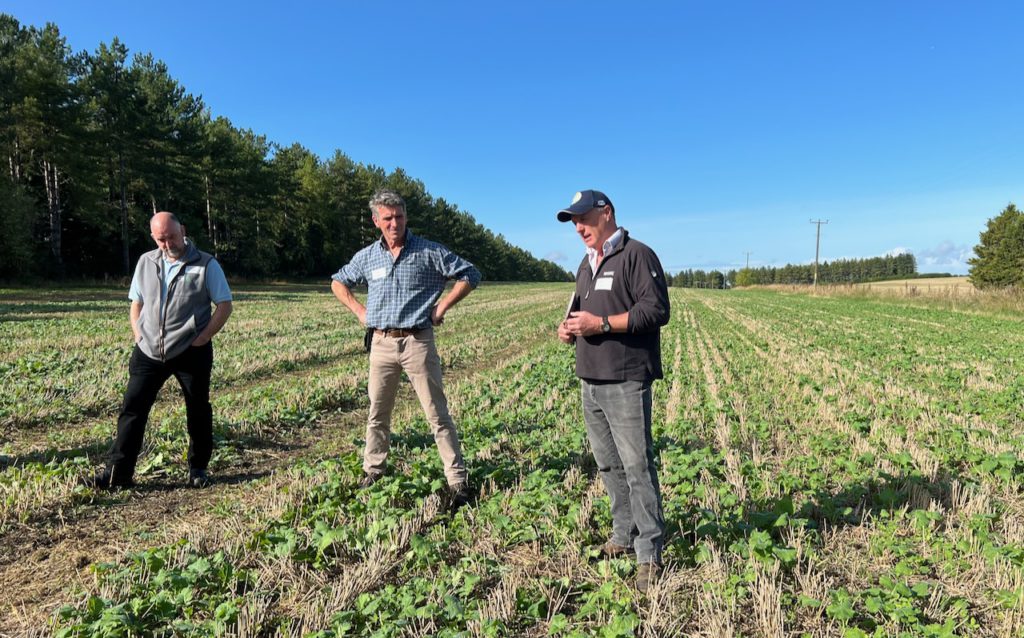
Delegates were then sent on a circuit of the farm  to join workshops on best practice grazing, livestock feed self-sufficiency and crop cultivation and diversity. 

We have captured the nuggets from the workshop discussions below:

Grazing clinic – chaired by Rob Purdew (FCT)

We heard from Rich Stanbury (Beef and sheep farmer from Exmoor), Andrew Rees (Dairy farmer from Wales) and  Tim Williams (FNZ demo farmer).

Rich Stanbury runs a beef and sheep system that previously included arable for feed but he has recently been  able to take out all his arable land and move to an entirely home grown forage system with 150 suckler cows and 1100 ewes that are out all year. 
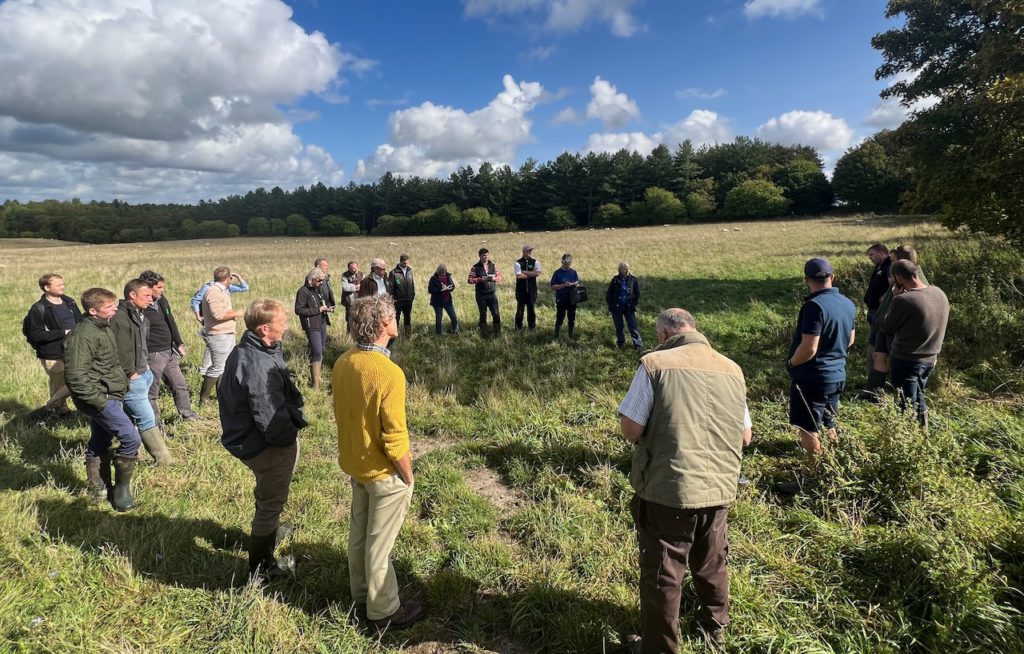
He’s taken part in an  Innovative Farmer’s Trial using a diverse forage crop mix as a break. They planted a field with kale on one half and a 16 species forage mix on the other half. Within three months, there was a visible difference in soil structure between the forage mix and the kale (that Rich could hardly believe). What’s more the forage mix provides diverse nutrition for the sheep and cattle – in Rich’s words, “the cows don’t just want to eat steak, they want peas and chips which is why the mix is good for livestock”.

Andrew Rees has a dairy herd that is now grass-based. He has transitioned the farm to spring calving and reduced his chemical inputs and artificial N fertiliser from 300 kg N/ha gradually and is on track to avoid all  chemical Nitrogen fertiliser use next year. He has done this by focussing on diverse pastures but explained that small actions like bale grazing young stock and using summer forage mixes have been useful stepping stones whilst transitioning the farm.

Tim Williams grew up on sheep and beef farms in New Zealand before moving to manage a dairy unit in NZ. After managing farms in both the UK and back in NZ, he learnt more about rotational grazing using the Kiwitech system . Now he is contract farming in Cornwall helping to showcase a regenerative system for the Farm Net Zero project. The farm was previously arable land which had become severely degraded. Tim has transitioned this to a perennial system which started with the initial introduction of a 30 species mix cover crop and the grazing of a small suckler herd that has been built up with store heifers and pedigree Angus. Tim is aiming for 100 head of cattle but is building the herd gradually. He has been bale grazing for energy to be able to overwinter the calves. He is achieving 1 kg LWG per day for growing cattle on this diverse perennial mix.

What was the moment you knew your new approach was working?

  • Tim It immediately followed the lowest point. Three years of hard graft and nearly reaching breaking point in Spring 2023 with it being so dry, worrying that there wouldn’t be anything for the cattle to eat, and then the growth taking off and it being amazing.
  • Rich As a fourth generation on the same farm, the negativity from family and neighbours was difficult. Having lots of knowledge to back up the transition helped. Now, a few years down the line, having no N inputs and having to increase the stocking rate because we’re growing more grass than when we were buying in N, that’s how I know it’s working. 
  • “Farmers don’t like change, but when they see that something is really working, they will eventually make the change themselves .

Wasn’t a 16 species or 30 species cover crop expensive? How did you choose what to sow?

  • It was possible to reduce the sowing rate of the 16 way mix. Agronomists are not typically interested in advising on seed mixes because what they really want to sell you is N fertiliser
  • Sunflower, sorghum and millet were successful  plants to include in the seed mixture and  pump a lot of carbon into the soil which benefits the structure, but he found sorghum didn’t establish well on his farm.
  • It’s very easy to overspend on mixes and seeds. Plan carefully. You can get an SFI SAM3 (similar to GS4) and stack options to make it pay. 
  • Think of it a different way: they saw a 500g /day liveweight gain in sheep on the 16 way mix and a 30 kg increased liveweight gain  over winter on outwintered cattle grazed on the mix compared to housed cattle. So the benefits can outweigh the expense of the seed.
  • You may not need to resow. You can get the animals to disperse the seed for you (so seed one field and then graze the livestock on that after it’s set seed, then move them to where you want that seed to grow next).
  • You may not need to sow at all. Permanent pasture left ungrazed or “rested” might be able to be put into GS4 to get a payment with none of the seed cost!

What does a perennial system look like?

  • You have to be patient. You sow 16 or 30 species and it will seem like some don’t establish. Annuals will come first, that’s normal for succession. It might seem like the perennials have not appeared but they will gradually take over from the annuals. It’s important to have the annuals to cover the soil while the perennials establish and this prevents weeds. It’s succession.
  • Allowing the pasture to set seed is important as it allows a seed bank to be established (so you don’t have to resow).
  • Sheep will pick off the best bits and so you keep them moving. Then you can bring in the cattle to pull off the rest.

Crop cultivation and diversity – chaired by Tilly Kimble-Wilde (FCT)

We heard from Tim Parton (Green Farm Collective), Julian Gold (host farm), David Miller(Arable farmer from Hampshire)
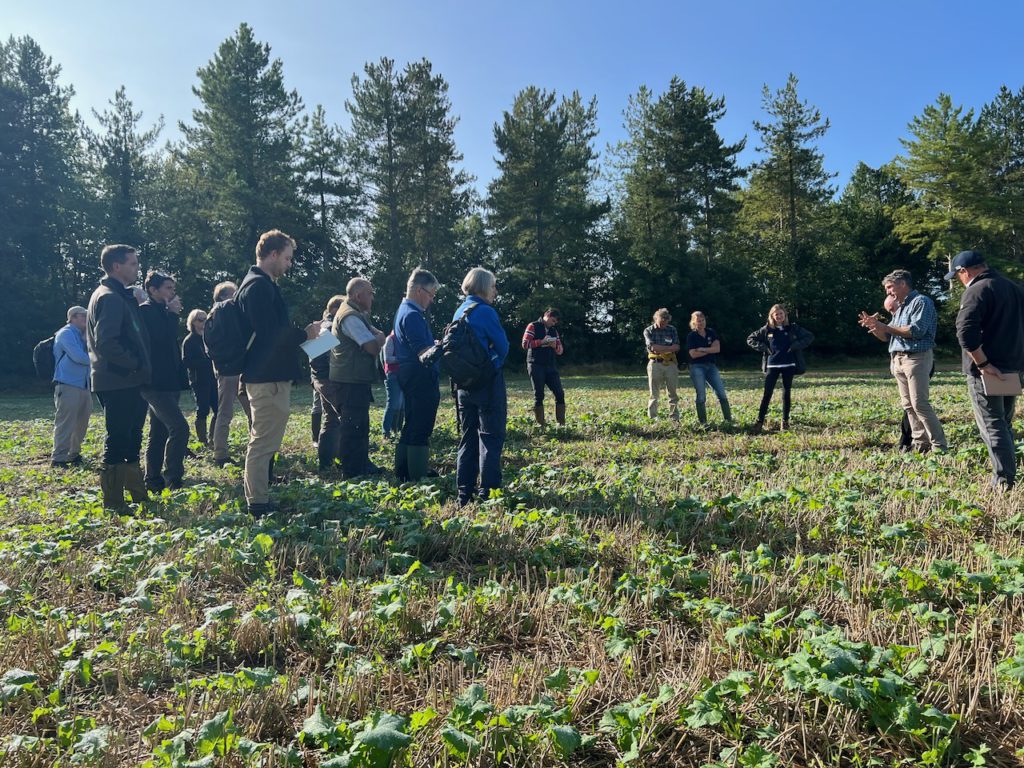
Feed self-sufficiency – chaired by Stefan Marks (FCT)

This session focussed on the ways in which farmers could become more self-sufficient in feed production. The session was introduced by Stefan, who explained that feed was a global commodity which is at risk of global price fluctuations, particularly recently, which can cause significant economic challenges on farm. The session explored how growing different crops could help enhance crop rotations, benefit plant and soil biodiversity and how to reduce inputs on-farm (including fertiliser and antibiotic usage). 

We heard from Michael Carpenter (Kelvin Cave) and Chris Berry (Devon farmer).

Michael highlighted the importance of making best use of what you can grow on your own farm, or trading with your neighbours, which will not only help profitability but also lower the farm carbon footprint. Discussions ensued about the importance of forage preservation and optimising milk from forage, highlighting the practical things that can be done on-farm to maintain quality including grass species, and numbers of cuts to minimise dry matter losses. Michael also talked about the benefits of crimped cereals, which provides higher dry matter yield per ha, a greater fibre digestibility in the seed coat before it lignifies, and more available protein in the cereal. As protein is a high cost (both economically and in terms of carbon) to the farm, cutting down the cost of protein is a good strategy. The NCS project was discussed which is aiming to provide practical information about how by growing peas and beans we can reduce the cost of protein and achieve economic, environmental and animal performance benefits. For more information on the NCS project please click here. https://farmcarbontoolkit.org.uk/2023/07/19/the-ncs-project-more-info/

Chris Berry farms 450 acres near Exeter, on dry sandy soil. Traditionally the farm was a mixed farm lambing Christmas and Easter, calving in the autumn and spring and growing cereals to feed back to the animals. As Chris came home he was asking a lot of questions about the system and its sustainability for the future. Having come back from New Zealand, Chris decided to change the system to become less reliant on subsidies.

The farm made the switch from lambing 700 ewes indoors and outdoors to one big flock of 7-800 New Zealand highlander ewes, and moved to an Angus breed on the cows to make the most of the forage based genetics. This was the starting point to transitioning the farm. At the beginning they were still using feed and fertiliser to make the system work, but gradually Chris came to the realisation that he also needed to focus on what was below the ground and making the best use of grass.

Previously the farm was growing 100ac res of barley, which was rolled and fed to the cattle alongside a lot of purchased creep. Chris started putting up electric fencing and rotating the stock around the paddocks. He started with lots of small groups and lots of moves, but through engaging with a discussion group and Precision Grazing, the system has now moved to include measuring grass and paddock grazing with existing leys (ryegrasses and clovers).

The system was working well, however there were still challenges in the dry summers, and so herbal leys were introduced to provide forage in June – August. Chris started with a 9 ha field which was sown with chicory, red and white clover, plantain and put 300 lambs on it and they gained 10kg in the month they were there. This was a turning point for Chris as he hadn’t managed to achieve  a similar growth rate on creep feed. Since then Chris has got rid of the land which was growing cereals and has put it into herbal leys.

Now he has a much more consistent supply of forage when he needs it to match the stock energy requirements. Chris has managed to reduce antibiotic use on farm by 75%, eliminate 80 tonnes of purchased creep feed, and reduced fertiliser by 33 tonnes, which has saved 156t of CO2e, along with an increased output from the farm from 240 to 280 kg per ha. 
Following lunch and a presentation to our FCT retiring Chairman David Gardner we all settled down for the afternoon to focus on ways to reduce fossil fuel energy usage and how best to benefit from the new emerging voluntary markets for carbon, biodiversity net gain and nutrient neutrality. 

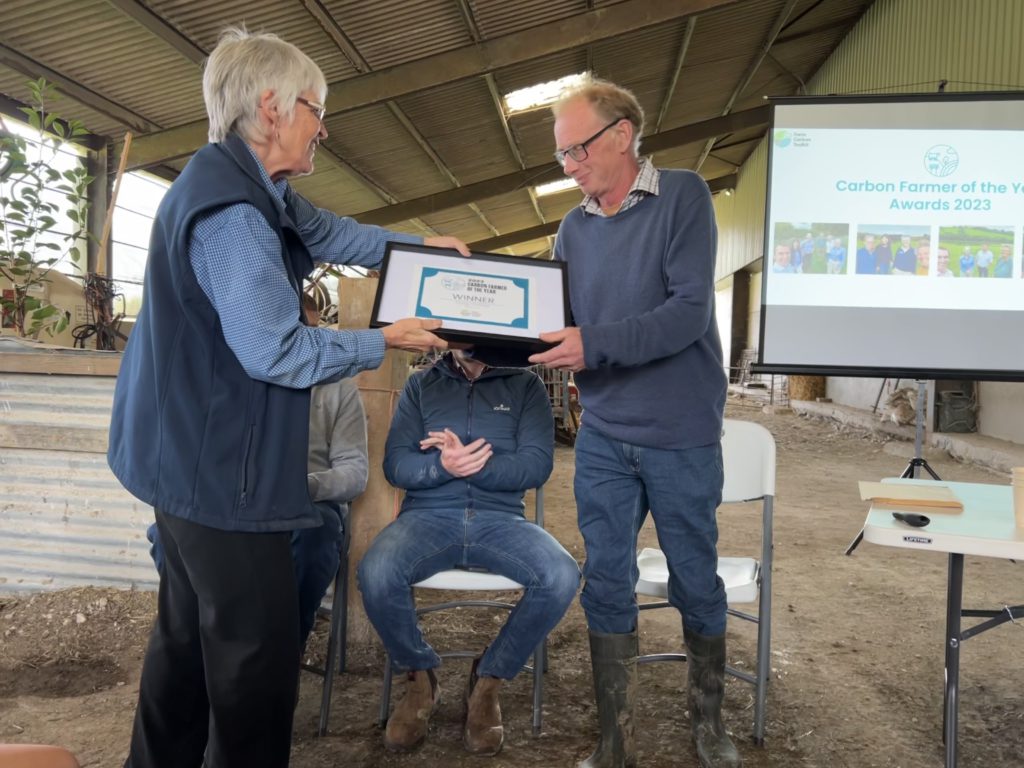
First out of the blocks was the awards for our new competition Carbon Farmer of the Year. 

FCT  set up this Competition  to recognise  and champion farmers, sector organisations and businesses who are leading the way in adopting farming practices and developing new technologies to reduce farm emissions whilst optimising output. 

We wanted to enable discussions on carbon emissions and sinks on farms to be framed in a very practical way to help everyone to increase their understanding and provide ideas for change.

Our judges were Adam Twine – our founder and long term advocate of climate friendly farming practices and mixed farmer from Wiltshire, David Cope, head of Sustainability at the Duchy of Cornwall and Emily Norton, farmer and chair of the Soil Association Exchange Advisory Group. 

Our four finalists were Anthony Ellis from Pensipple Farm, Cornwall, Craig Livingstone from Lockerley Estates, Hampshire, Doug Christie from Durie Farms, Fife and Thomas Gent from Oakley Farm, Cambridgeshire.
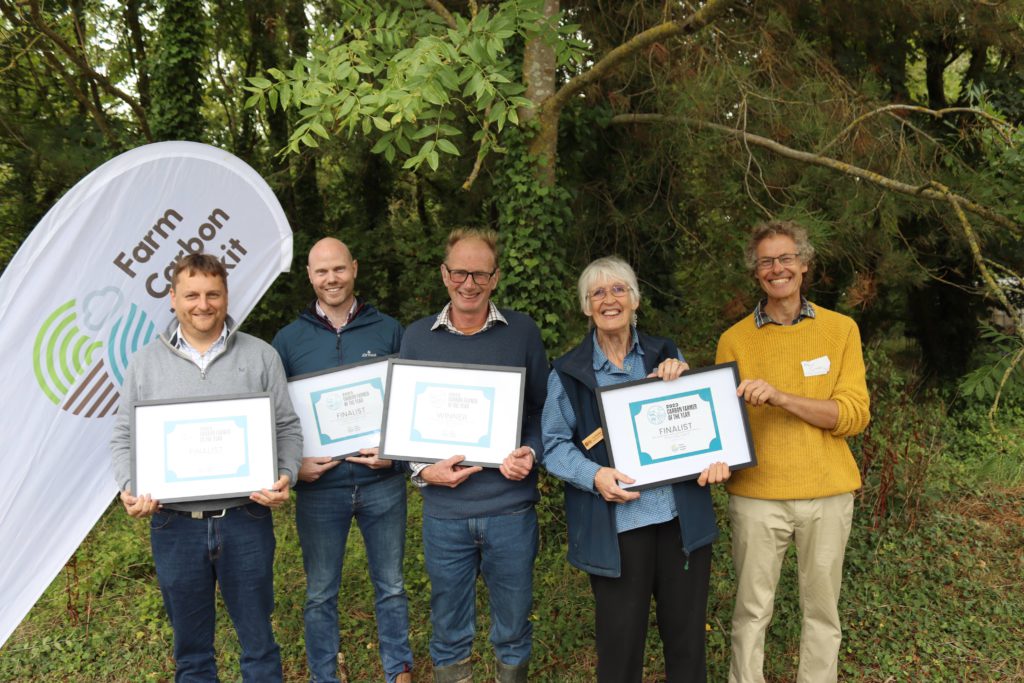
Carbon Farmer of the Year 2023 Winners

Doug Christie emerged as our winner. Doug has a mixed farm incorporating an arable enterprise and an organic beef herd alongside woodland.  He has been incorporating conservation agriculture practices increasingly since 1999 and was very much a pioneer of climate friendly farming when it was far from fashionable. He realised long ago that reducing emission heavy inputs would reduce his farm footprint. He has been doing that whilst working to improve soil health to enable crop yields to be optimised. Doug is an advocate for increasing natural capital and biodiversity on the farm which he believes underpins the farm’s resilience and truly sustainable food production. Testament to this focus on biodiversity is that Doug ceased using insecticides over 20 years ago. 

FCT will be holding a farm walk at Durie Farms on the 21st November to showcase what Doug is doing.

This was followed by a session to consider some of the opportunities for farmers to benefit from the new and emerging markets for carbon and biodiversity net gain as well as nutrient neutrality. Our speakers included Rob Shepherd, chair of the Environmental Farmers Group, Daniel Wynn, Head of Nature Based Solutions at Kent Wildlife Trust and Julian Gold from Hendred Estate and Nick Down from Velcourt Farms.  Rob spoke about the work of the Environmental Framers Group (EFG) as a farmer controlled business to enable its members to jointly benefit nutrient neutrality payment schemes across their area of activity which is currently central southern England but is expanding fast with over 1.5% ofEngalnd’s farmed area signed up for membership.  

Dan Wynn shared information on Wilder Carbon, a Kent Wildlife Trust subsidiary which is working with land owners and managers to draw down carbon payments from the development of  Nature Based Solution creation on land.  Dan talked delegates through the process and  talked about the pitfalls which are present in this landscape at the moment and how best to avoid them which crucially involves working with partners with integrity and being very clear about the agreements you are entering into as they are often very long term and will come with significant delivery requirements as  well as robust monitoring and verification.

Following Dan’s presentations two farmers, Julian Gold and Nick Down gave their perspectives on these markets. Julian from the point of view of having entered some land into a BNG agreement last year and now fully appreciating the long term requirements of meeting the agreement requirements and from Nick discussing how customer requirements are driving a focus on supply chain carbon insetting and how farmers can gain power in this space.  This topic drove discussion with delegates asking about future market requirements and how this might affect the attractiveness of current schemes available in this space.

Following this session we finished with a very practical session looking at reducing farm reliance on fossil fuel based sources of power. 
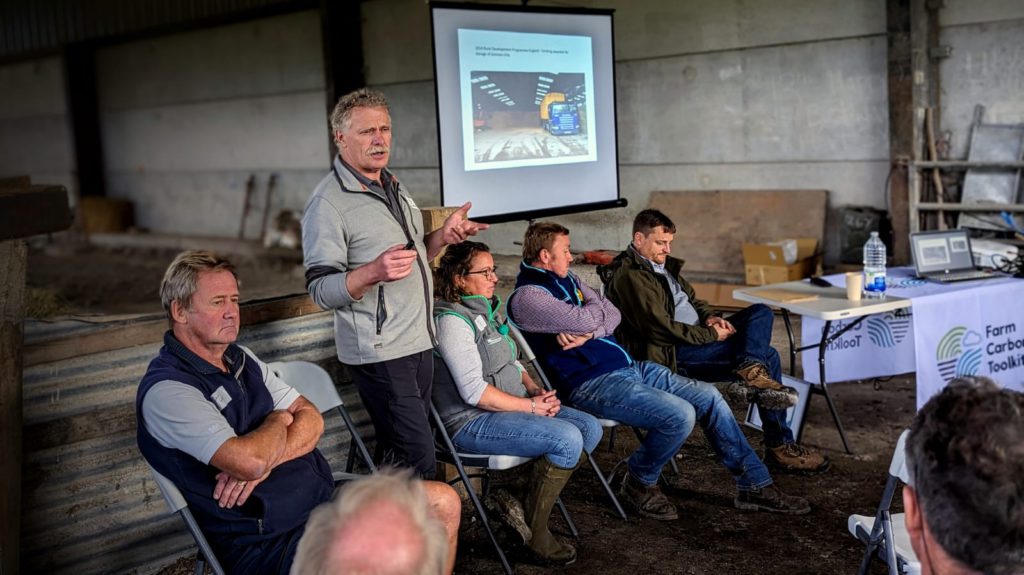
Three of our speakers in this session have reduced reliance on fossil fuels through the following technologies:

  • Harvesting biomethane from the farm’s slurry store to power on farm machinery and sell the surplus –  Katie and Kevin Hoare from Cornwall
  • Woodfuel as an alternative heat source – Andy Bradford from Dartmoor Woodfuel
  • Replacing diesel and heating oil with oats and chip fat – Anthony Ellis from Cornwall
  • An analysis of alternative non-fossil fuel sources – David Gardner reviewed the future potential for  power derived from solar and wind versus hydrogen with the conclusion that the invention of solid state batteries will give a significant advantage to electric motors powered by batteries or the grid due to their superior  power translation into available power at the point of requirement.

We will be uploading slides from these sessions onto our website in due course so that you can look in detail at their presentations. 

Kindly supported by:
Yeo Valley, Velcourt and First Milk.

Carbon Farmer of the Year 2023 – Review

Carbon Farmer of the Year 2023 Winners

Why did Farm Carbon Toolkit create this competition?

Farm Carbon Toolkit (FCT) set up the Carbon Farmer of the Year Competition to recognise and champion farmers, sector organisations and businesses who are leading the way in adopting farming practices and developing new technologies to reduce farm emissions whilst optimising output. 

We wanted to enable discussions on carbon emissions and sinks on farms to be framed in a very practical way to help everyone to increase their understanding and provide ideas for change.

We are clear that we all face the imperative to reach net zero by 2050 and for farmers that means identifying where all possible reductions in greenhouse gas emissions can be made alongside removing carbon where possible into soils and woody biomass.

Through this competition we were seeking businesses who are implementing effective mitigation practices and adopting new technologies which are helpful and provide inspiration for others to emulate.

The judging process

Having opened the competition for entries we were delighted to see so many high-quality entries flooding in from all over the country. We assembled a team of judges who we felt would be able to look at all aspects of our entrants’ applications:

  • Adam Twine – our founder and long-term advocate of climate friendly farming practices and mixed farmer from Wiltshire,
  • David Cope, head of Sustainability at the Duchy of Cornwall and
  • Emily Norton, farmer, and chair of the Soil Association Exchange Advisory Group.

We interrogated all the entries to select our four finalists – Anthony Ellis from Pensipple Farm, Cornwall, Craig Livingstone from Lockerley Estates, Hampshire, Doug Christie from Durie Farms, Fife and Thomas Gent from Oakley Farm, Cambridgeshire.

Our judges visited all four farms to see for themselves the practices of the businesses, the ethos of the entrants and the impact on emissions, sequestration, and farmland biodiversity. It was clear that all our finalists were committed to making rapid and significant changes to their businesses to reduce greenhouse gas emissions. This made the final decision to choose our first winner difficult.

Our 2023 winner

Ultimately, we agreed that Doug Christie of Durie Farms, Fife should be our 2023 winner.  Doug has a mixed farm with beef cattle and arable cropping and is organic for the grassland and livestock. He has been incorporating conservation agriculture practices increasingly since 1999 and was very much a pioneer of and advocate for climate friendly farming when it was far from fashionable. Doug initially focused on soil health and by doing this soon realised that it also provided  a platform by which emission heavy inputs were reduced with  a corresponding reduction in his carbon footprint while also enhancing natural capital  services such as biodiversity, water quality,  reduced diffuse pollution, water infiltration as well as overall farm resilience, a tall order while attempting to optimise  sustainable output. Testament to this focus on biodiversity is that Doug ceased using insecticides over 20 years ago.

Doug Christie being awarded Carbon Farmer of the Year 2023 at FCT's Annual Field Day
Doug Christie being awarded Carbon Farmer of the Year 2023 at FCT’s Annual Field Day

We asked all our entrants to tell us about the key practice changes they have made to help them to reduce emissions and remove carbon. Doug’s list was extensive including direct drilling of arable crops; multi species cover crops preceding spring crops; more diverse crop rotation including the production of pulses and legumes; introduction of companion and intercropping more than six years ago; keeping soil covered  at all times, maximising use of living roots throughout the year and avoiding any activity on fields when ground conditions are adverse. This has allowed Doug to sell his subsoiler years ago.

Since 2009, use of granular urea has reduced by over 30%, due partly to the increased area of legumes grown. On the arable rotation output has slightly reduced but net margins are up.

On the livestock side Doug practises adaptive multi paddock grazing with diverse leys which underpins soil fertility; this, in turn, has led to reducing  the winter housing period for cattle and minimising use of supplementary feeding. A welcome impact of changing housing management has been a significant reduction in both costs and emissions from a reduced need to move feed and bedding around in the winter and reduced emissions associated with producing winter forages and constantly reseeding.

While he is a firm believer that the five principles of soil health will ultimately deliver he also makes use of technologies such as yield mapping, NDVI and to identify areas to prioritise for nature and is a great believer in monitoring input use and soil health . Records of organic matter (LOI) on a field basis go back to 2006. OM levels rose by a modest 0.5%  (from 2006 to 2016) but have not carried out the same statistical analysis from 2016 to present yet.  This needs to be seen against a high starting point, taking into consideration the soil type (mainly sandy loam).

He has monitored fuel usage for farm activities for the past five years and has comprehensive soil analysis information going back for well over two decades. This information has then been used to guide future farm management.

Key measures to reduce use of fuel and energy at Durie Farms primarily focus on reducing the need for power, through for example reduced on farm feed mill and  mixing as feed use has declined and reduced lighting for housed livestock, use of a stripper header, keeping tyre pressures optimum; reducing total tractor hours / year, low tractor HP / axle weights as well as changing overall farm systems to reduce the need for the use of machinery and equipment. Data on fuel usage going back to 2018 indicates that fuel usage for the cattle enterprise has reduced by 24% during this period with the arable enterprise fuel use, stubble to stubble and including cover crops averaging 12.21 litres/tonne or 53 litres / ha, before fuel for drying crops which has fluctuated from 5 – 20 litres / tonne (including fuel for generator to power the drier) fluctuations mainly due to moisture of crops at harvest. 

Doug is continually trying new ideas, with pasture cropping a new initiative he has ‘frustratingly’ tried this year.

Going forward there is a list of things he is looking at to reduce emissions further and store more carbon on the farm, for example developing agroforestry on the permanent grassland to provide benefits for livestock and introducing diverse leys into the arable rotation to enable further reductions in fossil fuel fertiliser usage whilst enhancing soil carbon levels.  Dug has calculated that this will reduce reliance still further on chemical N Fertilisers (50% reduction on current levels). For this change Doug will need to balance available forage with cattle requirements.

As a mixed farm, the largest source of emissions are the beef cattle on the farm, despite all the very positive practices in place on the farm. However, looking more holistically, the benefits of the cattle in providing manures and extensive use of legumes to replace chemical fertilisers and supporting enhanced biodiversity contributes to effective ecosystem services which in turn supports a pesticide free system. They are the kingpin to a more circular farming system.

Effective communication and networking

Durie Farms network is extensive, ranging from BASE UK; working closely with local research institutions with on farm trials; involvement with the local AHDB strategic farm alongside hosting visits from Government and other groups on farm.  

FCT will be holding a farm walk at Doug’s farm on the 21st November as part of Countryside COP week. More details will be published over the coming week. 

FCT Long term ambition for the Carbon Farmer of the Year

In the long term, the Farm Carbon Toolkit is aiming to create a network of alumni who are changing their management practices to better manage emission and carbon storage on farmland who will inspire others through activity, practical demonstrations, and advocacy for changing management practices.  

Farm Carbon Toolkit – Carbon Farmer of the Year Winners announced!

The winners of our inaugural Carbon Farmer of the Year competition are:

Overall winner:

Doug Christie from Durie Farms, Leven, Fife, Scotland

Finalists:

  • Anthony Ellis from Pensipple Farm, Liskeard, Cornwall
  • Craig Livingstone and Matt Bloor from Lockerley Estate and Preston Farms, Broughton, Stockbridge, Hampshire
  • Thomas Gent from Oakley Farm, Tydd St Giles, Cambridgeshire

Photo above: Winner Doug Christie (left) with judges Emily Norton, Liz Bowles and Adam Twine with his Angus cattle.

Our judges Adam Twine (FCT Founder and non-executive director), David Cope (Duchy of Cornwall), Emily Norton (Chair of Soil Association Exchange), and Liz Bowles (FCT CEO) were very impressed with the commitment and innovation shown by all the finalists in identifying sources of GHG emissions and developing strategies to reduce emissions and increase the rate of carbon removal into soils and non-crop biomass.

This year’s winner stood out to the judges for his dogged determination in identifying how best to reduce emissions, whilst reducing reliance on those external inputs which he realised long ago came with unintended consequences. When Doug started his journey towards a low emission, regenerative farming system, it was far from popular.

All our finalists have made great strides in reducing business reliance on fossil-fuel based fertilisers and fossil fuels through changes to their farming practices and careful soil management to reduce GHG emissions.

The long-term objective of this competition is to create a network of alumni who are changing their management practices to better manage emission and carbon storage on farmland who will inspire others through activity, practical demonstrations, and advocacy for changing management practices.

Network creation is of paramount importance and this competition will raise the profile of the many effective ways in which on-farm emissions can be reduced and increased carbon storage can be achieved.

Emily Norton, Farmer and chair of the Advisory Board for Soil Association Exchange, says

“I was interested to see the range of approaches being taken by the finalists and was delighted that so many businesses were brave enough to put themselves forward to be judged on something which is a relatively new concept for Agriculture”

About the Farm Carbon Toolkit and the Carbon Farmer of the Year Competition

Farm Carbon Toolkit is an independent, farmer-led Community Interest Company, supporting farmers to measure, understand and act on their greenhouse gas emissions, while improving their business resilience for the future.

For over a decade, Farm Carbon Toolkit has delivered a range of practical projects, tools and services that have inspired real action on the ground. Organisations they work with include the Duchy of Cornwall, First Milk, Dartmoor National Park, Tesco, Yeo Valley and WWF. The Farm Carbon Calculator is a leading on-farm carbon audit tool, used by over 7,000 farmers in the UK and beyond. To find out more visit www.farmcarbontoolkit.org.uk

The Carbon Farmer of the Year Competition aims to recognise and champion farmers, sector
organisations and businesses who are leading the way in adopting farming practices and developing new technologies which are helping to reduce farm emissions whilst optimising output.

This new competition will allow for discussions on carbon emissions and sinks on farms to be framed in a very practical way to allow for maximum engagement with the issue. Farm Carbon Toolkit facilitates discussion and information sharing between farmers and other actors which ultimately leads to changes in on-farm practice.

Next year’s competition will be launched in February 2024.

Press release: 2024 CFOTY finalists announced!

Farm Carbon Toolkit announces shortlisted farms for the 2024 Carbon  Farmer of the Year competition 

Four farmers from across the UK – including three dairy farms – have been shortlisted for this year’s Carbon Farmer of the Year competition in recognition of their efforts to reduce their business’s climate impact.

The 2024 Carbon Farmer of the Year Shortlist:

  • Andrew Brewer from Ennis Barton, Fraddon, Cornwall (Arla supplier)
  • Jason Mitchell, Gary Logue and Adam Moore from Greenville Dairies Ltd, Newton Stewart, Northern Ireland  (Lakeland supplier)
  • Tom Burge from Oaremead Farm, Lynton, Devon 
  • Wesley Semple from Derryduff Farm, Dungiven, Northern Ireland  (Lakeland supplier)

Now in its second year, the annual Carbon Farmer of the Year competition is organised by the Farm Carbon Toolkit and generously sponsored by HSBC Agriculture UK.

The competition aims to find farmers and growers who are engaged with, and passionate about reducing their business’s climate impact through changing management practice to reduce greenhouse gas emissions from their businesses. 

As part of the competition, the top three farmers will host free farm walks that bring farmers together to share good practice and innovations that result in reduced emissions, as well as improving carbon removal into soils, trees, hedges and non-crop biomass. The competition is becoming widely recognised by organisations working to reduce the emissions from UK agriculture, with many promoting it to their networks to increase participation.

Rob Purdew, Farm Carbon and Soil Advisor with Farm Carbon Toolkit, says 

“We’ve been blown away by the quality of the entries for this year’s Carbon Farmer of the Year competition The sheer variety of entries for this year’s competition highlights the fact that, despite differences in farming systems and locations, many farmers are finding truly innovative ways to reduce their business greenhouse gas emissions.

It is particularly positive to see three dairy farmers in this year’s shortlist, given that dairy farming is often in the media spotlight in terms of its environmental impact. We are working with numerous dairy farmers and dairy industry projects that are already showcasing that this doesn’t need to be the case, and that farmers can make simple management changes to significantly improve their carbon and environmental footprints. We’re grateful to everyone who took the time and effort to enter.

Steve Dunkley, HSBC Agriculture, says 

HSBC UK Agriculture is pleased to support the 2024 Carbon Farmer of the Year competition and  the quality of entries has been superb and hugely inspiring. As a business, we’re very keen to support the industry in transitioning towards net zero. While that will take many forms, we have the ambition to help farmers fund investment in the new practices and technologies needed to evolve. The Carbon Farmer of the Year competition is a great way of showcasing how farmers are already achieving these changes and encouraging others to follow their lead.

The judging process now involves visiting each of the four finalists to learn more about their farming practices before selecting the winners.

The winners of the 2024 Carbon Farmer of the Year competition will be announced at the Farm Carbon Toolkit Annual Field Day on the 26th September 2024, this year kindly hosted by 2023 Soil Farmer of the Year winner Billy Lewis at Boycefield Farm, Dilwyn, Herefordshire. A day for farmers, by farmers, the FCT Annual Field Day is about sharing practical experiences for improving performance and resilience in a challenging environment with this year’s event focusing on the value of mixed farming.

Open farm walks at the top three farms will be scheduled to take place in November and December 2024.

For further details about the 2024 Carbon Farmer of the Year competition, contact Rob Purdew, Carbon and Soil Advisor with the Farm Carbon Toolkit, at Rob.Purdew@farmcarbontoolkit.org.uk

For more information, visit www.farmcarbontoolkit.org.uk/carbon-farmer-of-the-year/

Notes to Editors

Farm Carbon Toolkit is an independent, farmer-led Community Interest Company, supporting farmers to measure, understand and act on their greenhouse gas emissions, while improving their business resilience for the future.

The Farm Carbon Calculator uses the IPCC 2019 and UK GHG Inventory methodologies and is aligned with the GHG protocol agricultural guidance.  Recent development has allowed us to provide greater interoperability with other data platforms through our Report Export API and Carbon Calculation Engine API. This represents a step-change in the industry’s ability to provide trustworthy carbon footprints with transparent methodologies on platforms where farmers already collect data, thus reducing the data inputting onus on farmers. This new functionality has been warmly welcomed by supply chain businesses who are now using our Calculation Engine to support their customers without need for further data entry.

The Farm Carbon Calculator is used across the UK and on four continents with  global usage growing at around 20% per year.

For over a decade, Farm Carbon Toolkit has delivered a range of practical projects, tools and services that have inspired real action on the ground. Organisations they work with include the Duchy of Cornwall, First Milk, Tesco, Yeo Valley and WWF. The Farm Carbon Calculator is a leading on-farm carbon audit tool, used by over 8,000 farmers in the UK and beyond. To find out more visit www.farmcarbontoolkit.org.uk  

Carbon Farmer of the Year competition -update

Earlier this year we at the Farm Carbon Toolkit launched our Carbon Farmer of the Year (CFOTY) competition. With this competition we will be recognising and championing farmers, sector organisations and businesses who are leading the way in adopting farming practices and developing new technologies which are helping to reduce farm emissions whilst optimising output. 

Back in 2015 we launched our Soil Farmer of the Year (SFOTY) competition which recognises those farmers who are going above and beyond to support improved soil health on their farms and to showcase all the good things which flow from that enhanced soil quality. This competition has been highly successful at celebrating incredibly forward thinking farmers and through it we have been able to share their methods, spreading their knowledge and normalising practices that may have previously seemed intangible to many farmers. The approaches these farmers have been demonstrating through the highly popular SFOTY farm walks have been a great opportunity to show to others that increasing soil health to safeguard our soils for future generations and future food production can be achieved whilst maintaining profit and production. 

We are confident that our new Carbon Farmer of the Year competition will do the same as the SFOTY, but with a focus on carbon reduction and carbon sequestration.

We are looking for those farmers and other businesses who are doing great things to reduce farm emissions and to store carbon in soil and non-crop biomass within resilient, biodiverse businesses. We believe the more we celebrate and recognise those farmers that are leading the way with regards to reducing emissions, increasing carbon capture and minimising reliance on imported energy the more we can spread this knowledge, create a new norm and share best practice across the industry. 

All the details to make nominations/apply and the entry form are available on our website here. Or you can go straight to the nomination/application form here.

Entries close on the 4th July and we will be announcing the winners at our annual Farm Carbon Toolkit Field Day on the 21st September.

Please note – the Soil Farmer of the Year competition will still be running alongside this new competition, and as always we will be announcing the winners at Groundswell in late June. 

Press Release: Launch of new Carbon Farmer of the Year Awards

Farm Carbon Toolkit launches the first competition of its kind at the Low Carbon Agriculture Show this February. 

The annual Carbon Farmer of the Year Competition aims to recognise and champion farmers, sector organisations and businesses who are leading the way in adopting farming practices and developing new technologies that are helping to reduce farm emissions while optimising output. 

Launched today at the Low Carbon Agriculture Show at NAEC Stoneleigh, this is the only competition of its kind to identify and reward farmers, sector organisations, and businesses that are working hard to manage emissions and carbon storage. The competition will allow stakeholders to frame discussions on carbon emissions and carbon sinks on farms in a very practical way, thereby encouraging maximum engagement with the issues.

The winners of this year’s Carbon Farmer of the Year competition will be announced at the Farm Carbon Toolkit’s annual autumn conference, which is being held at the Hendred Estate, Oxfordshire.

Farm Carbon Toolkit was established to facilitate discussion and information sharing between farmers and other actors, ultimately leading to changes in on-farm practice. With many years of experience of working with farmers, landowners and the wider agricultural community, Farm Carbon Toolkit understands that network creation is of paramount importance. 

Together with the wider work of the Farm Carbon Toolkit, the new competition will help to increase levels of carbon literacy among farmers and land managers by bringing them together at a number of dedicated events and workshops to share what they are doing, discuss new innovations in machinery and techniques, as well as learn more about new research and link with related projects. 

Adam Twine, Co-Founder and Non-Executive Direct at Farm Carbon Toolkit, says 

“The new Carbon Farmer of the Year competition will help to create a network of respected alumni who are not only changing their practices to better manage emissions and carbon storage on farmland, but will help to inspire others through activity, practical demonstrations, and advocacy for changing management practices.”

By showcasing the good practices that are taking place on farms across the UK, the Carbon Farmer of the Year competition will encourage more farmers to appreciate what is possible for their own businesses, specifically around changing practices to reduce emissions, improve soil organic matter levels, water holding capacity, soil life and soil structure, and the many other positive consequences associated with these changes.  

Liz Bowles, Chief Executive Officer at Farm Carbon Toolkit says, 

“I am delighted to announce the new Carbon Farmer of the Year competition, which will reward those individuals and organisations in the farming sector who are pioneering practices and adopting new technologies to reduce the GHG emissions from agriculture. Our ambition with this competition is to showcase best practices and effective mitigation mechanisms that are realistic and practicable on every farm, and help everyone to increase their carbon literacy.”

For more information about the Carbon Farmer of the Year Competition, and for details on how to apply, visit www.carbonfarmeroftheyear.com

Notes for editors

About the Farm Carbon Toolkit

Farm Carbon Toolkit is an independent, farmer-led Community Interest Company, supporting farmers to measure, understand and act on their greenhouse gas emissions, while improving their business resilience for the future.

For over a decade, Farm Carbon Toolkit has delivered a range of practical projects, tools and services that have inspired real action on the ground. Organisations they work with include the Duchy of Cornwall, First Milk, Tesco, Yeo Valley and WWF.  Their Farm Carbon Calculator is a leading on-farm carbon audit tool, used by over seven thousand farmers in the UK and beyond. To find out more visit www.farmcarbontoolkit.org.uk